Plik:PIA17993-DetectorsForInfantUniverseStudies-20140317.jpg


Opis
| Opis |
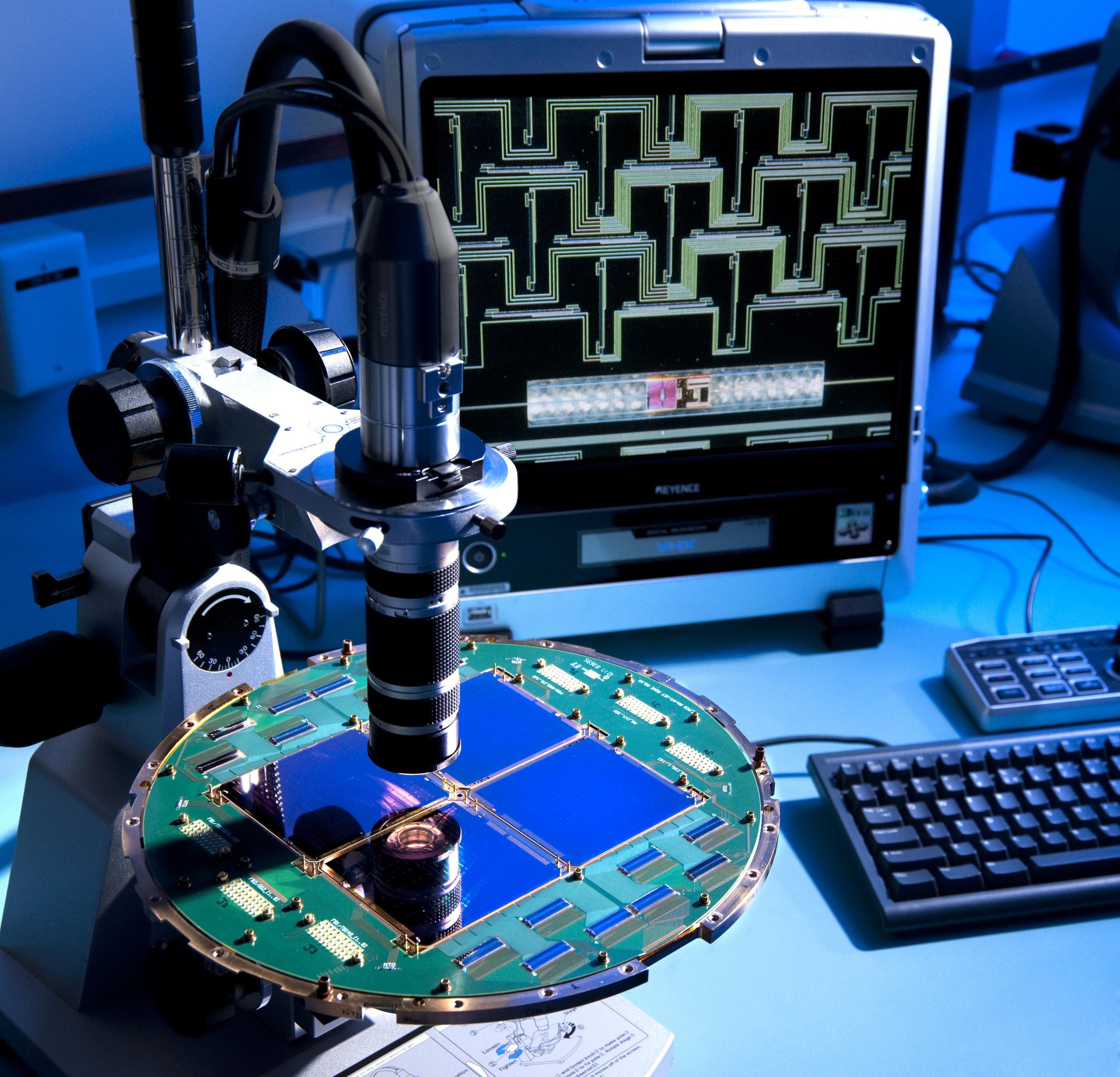
English: Superconducting Detectors for Study of Infant Universe
http://www.jpl.nasa.gov/spaceimages/details.php?id=PIA17993 http://www.jpl.nasa.gov/news/news.php?release=2014-082 The BICEP2 telescope at the South Pole uses novel technology developed at NASA's Jet Propulsion Laboratory in Pasadena, Calif. The focal plane shown here is an array of devices that use superconductivity to gather, filter, detect, and amplify polarized light from the cosmic microwave background -- relic radiation left over from the Big Bang that created our universe. The microscope is showing a close-up view of one of the 512 pixels on the focal plane, displayed on the screen in the background. Each pixel is made from a printed antenna that collects polarized millimeter-wavelength radiation, with a filter that selects the wavelengths to be detected. A sensitive detector is fabricated on a thin membrane created through a process called micro-machining. The antennas and filters on the focal plane are made from superconducting materials. An antenna is seen on the close-up shot in the background with the green meandering lines. The detector uses a superconducting film as a sensitive thermometer to detect the heat from millimeter-wave radiation that was collected by the antenna and dissipated at the detector. A detector is seen on the close-up shot in the background to the right of the pink square. Finally, a tiny electrical current from the sensor is measured with amplifiers on the focal plane called SQUIDs (Superconducting QUantum Interference Devices), developed at National Institute of Standards and Technology, Boulder, Colo. The amplifiers are the rectangular chips on the round focal plane. The focal planes are manufactured using optical lithography techniques, similar to those used in the industrial production of integrated circuits for computers. |
| Data | |
| Źródło | http://photojournal.jpl.nasa.gov/jpeg/PIA17993.jpg |
| Autor | NASA/JPL-Caltech |
Licencja
  |
This media was created by the Jet Propulsion Laboratory (JPL) at Caltech. Their website states: "Unless otherwise noted, images and video on JPL public web sites (public sites ending with a jpl.nasa.gov address) may be used for any purpose without prior permission, subject to the special cases noted below. Publishers who wish to have authorization may print this page and retain it for their records; JPL does not issue image permissions on an image by image basis." Conditions:
By electing to download the material from this web site the user agrees:
Special Cases:
Usage on the English Wikipedia: On the English Wikipedia you can use the {{JPL Image}} template to display the copyright notice. (See Wikipedia:Using JPL images for details) |
Historia pliku
Kliknij datę lub czas, aby zobaczyć, jak plik wyglądał w tamtej chwili.
| Data i czas | Miniatura | Wymiary | Użytkownik | Opis | |
|---|---|---|---|---|---|
| aktualny | 22:13, 17 mar 2014 | | 3000 × 2884 (842 KB) | wikimediacommons>Drbogdan | User created page with UploadWizard |
Lokalne wykorzystanie pliku
Żadna strona nie korzysta z tego pliku.
